What Does the Vacuum Pump Do on a Car?
A vacuum pump is an essential component in many modern vehicles, and what does the vacuum pump do on a car is provide a steady vacuum source for critical systems. It helps operate the brake booster, which ensures you have enough power assist when pressing the brakes. Additionally, it supports other systems like turbochargers, exhaust gas recirculation valves, and certain emission controls that rely on vacuum pressure.
Without a functioning vacuum pump, your car may experience hard brake pedals, reduced braking efficiency, and poor engine performance. Some engines, especially diesel engines, don’t naturally produce enough vacuum, making the pump vital for safe and smooth operation. Warning lights, unusual noises, or leaks are common signs that the vacuum pump may need inspection or replacement.
Understanding the role of the vacuum pump can help you identify issues before they become serious. Regular maintenance ensures better braking response, improved engine efficiency, and longer lifespan for related components.
Key Takeaways
- Essential for Braking: The primary role of the vacuum pump on a car is to provide vacuum assistance for the power brake booster, making your brake pedal easy to press and ensuring effective stopping power.
- Not All Cars Have One: Naturally aspirated gasoline engines typically generate enough vacuum from the engine intake manifold. Diesel engines and forced-induction (turbocharged/supercharged) gasoline engines usually require a dedicated vacuum pump because they don’t produce sufficient natural vacuum.
- Supports Multiple Systems: Beyond brakes, the vacuum pump supplies vacuum for various other systems, including HVAC controls, emission control components (like the EGR valve), turbocharger wastegate actuation, and sometimes even cruise control.
- Signs of Failure Are Noticeable: A failing vacuum pump often presents clear symptoms, such as a hard brake pedal requiring significant effort, unusual noises (like squealing or ticking), dashboard warning lights, or issues with systems like HVAC.
- Safety and Performance Impact: A malfunctioning vacuum pump can severely compromise driving safety due to reduced braking effectiveness and can also lead to poor engine performance, increased emissions, and comfort issues.
- Professional Diagnosis Recommended: While some symptoms can be identified at home, diagnosing a vacuum pump issue accurately often requires a professional mechanic to confirm the problem and ensure proper repair or replacement.
Quick Answers to Common Questions
Why is my brake pedal suddenly hard to push?
A sudden hard brake pedal is the most common sign of a failing vacuum pump. It means your power brake booster isn’t getting enough vacuum assist, making you rely solely on leg strength to stop the car. This requires immediate attention for safety.
Can I still drive my car if the vacuum pump is bad?
While your car might still move, driving with a bad vacuum pump is highly dangerous, especially due to compromised braking. It’s strongly advised to avoid driving and have it repaired as soon as possible to ensure your safety and the safety of others.
How can I check my vacuum lines for leaks?
Visually inspect all visible rubber and plastic vacuum lines under the hood. Look for cracks, fraying, or loose connections. You can also listen for a hissing sound when the engine is running, which might indicate a vacuum leak.
Are electric vacuum pumps better than engine-driven ones?
Electric vacuum pumps offer benefits like providing consistent vacuum independently of engine speed (useful for hybrids or start-stop systems) and often being more energy-efficient. Engine-driven pumps are simpler but directly tied to engine operation.
What’s the typical cost to replace a vacuum pump?
The cost to replace a vacuum pump varies widely based on car make/model, pump type (mechanical vs. electric), and labor rates. Parts can range from $100-$500+, with labor adding another $100-$400, sometimes more for complex installations.
Understanding Engine Vacuum: The Basics
Before we discuss what the vacuum pump does on a car, let’s talk about “vacuum” in an engine. In simple terms, engine vacuum refers to a pressure lower than the outside atmospheric pressure. Think of it like a giant straw. When an engine’s pistons move down, they pull air into the cylinders. This creates a low-pressure area, or vacuum, in the intake manifold.
For many years, car manufacturers used this natural engine vacuum to power various accessories. This included things like power brakes, heating and air conditioning (HVAC) controls, and even some emission systems. It was a clever way to use a byproduct of engine operation to help other parts of the car work.
However, not all engines create enough vacuum on their own. This is where the dedicated vacuum pump comes into play. It acts like a helper, ensuring there’s always enough vacuum pressure for all the systems that need it, no matter what kind of engine your car has.
Why Do Some Cars Need a Vacuum Pump?
This is a crucial point when you’re thinking about “what does the vacuum pump do on a car.” The need for a dedicated vacuum pump depends heavily on your car’s engine type. Let’s break down the differences:
Visual guide about What Does the Vacuum Pump Do on a Car
Image source: evpvacuum.com
Naturally Aspirated Gasoline Engines
Most older gasoline engines and many current, simpler ones are “naturally aspirated.” This means they draw air into the engine solely through the suction created by the pistons. When the throttle plate (which controls airflow) is partially closed, it creates a strong vacuum in the intake manifold. This natural vacuum is usually plenty to power systems like the brake booster.
So, if you have an older or a very basic naturally aspirated gasoline car, it might not have a dedicated vacuum pump at all. It relies on the engine’s own vacuum production.
Forced Induction (Turbocharged/Supercharged) Gasoline Engines
Modern gasoline engines often use turbochargers or superchargers. These are called “forced induction” systems. They use a compressor to force more air into the engine. This makes the engine much more powerful and efficient for its size. However, there’s a trade-off: forced induction engines often produce very little or no manifold vacuum, especially under acceleration. In fact, they can even create positive pressure (boost) in the intake manifold.
Because these engines don’t create enough natural vacuum, they absolutely need a separate vacuum pump. This dedicated pump ensures a constant supply of vacuum for essential systems, especially the brakes. Without it, your turbo car’s brakes would feel incredibly stiff.
Diesel Engines
Diesel engines operate differently from gasoline engines. They don’t have a throttle plate in the intake manifold to restrict airflow and create vacuum. Instead, they always pull in a full charge of air. Therefore, diesel engines inherently produce very little to no usable engine vacuum.
For this reason, every modern diesel car is equipped with a dedicated vacuum pump. The vacuum pump on a car with a diesel engine is vital for its brake system and other vacuum-operated components. Without it, diesel vehicles would simply not be able to function safely.
The Primary Role: Power Brake Assistance
By far, the most critical function of the vacuum pump on a car is to assist the power braking system. This is a huge safety feature. Imagine trying to stop a heavy vehicle with only your leg strength. It would be incredibly difficult and dangerous. The vacuum pump makes braking effortless and effective.
Visual guide about What Does the Vacuum Pump Do on a Car
Image source: iqsdirectory.com
How the Brake Booster Works
Your car’s brake booster is a large, round component located between the brake pedal and the master cylinder. It uses vacuum to multiply the force you apply to the brake pedal. Inside the booster, there are two chambers separated by a diaphragm. When you press the brake pedal, the booster uses the pressure difference between these chambers to push the master cylinder piston with much greater force than your foot alone could provide.
One side of the diaphragm is always connected to a vacuum source (either the engine manifold or the vacuum pump). The other side is exposed to atmospheric pressure when you press the pedal. This pressure difference is what provides the “power assist.”
The Vacuum Pump’s Contribution to Braking
So, what does the vacuum pump do on a car specifically for the brakes? It reliably creates and maintains the vacuum needed by the brake booster. In cars where the engine doesn’t produce enough natural vacuum (diesels and forced-induction gasoline engines), the vacuum pump is the sole source of this critical vacuum. It ensures that every time you step on the brake pedal, you have full power assistance, allowing for quick, confident, and safe stops.
Without a functional vacuum pump, the brake pedal would become very hard to push. You would have to apply significantly more force to achieve the same braking power. This is not only uncomfortable but also extremely dangerous, especially in emergency braking situations.
Other Critical Systems Aided by the Vacuum Pump
While braking is the star, the vacuum pump on a car is not a one-trick pony. It also supports several other important vehicle systems that rely on vacuum for their operation. These can vary depending on the car’s make, model, and year, but here are some common ones:
Engine Control Systems
Many modern engines use vacuum to control various engine components. This helps with emissions and performance.
Exhaust Gas Recirculation (EGR) Valve
The EGR valve helps reduce harmful nitrogen oxide emissions. It recirculates a small amount of exhaust gas back into the engine’s combustion chambers. Many EGR valves are vacuum-actuated. The vacuum pump provides the necessary vacuum to open and close this valve precisely, allowing the engine’s computer to control emissions effectively.
Turbocharger Wastegate or Bypass Valve
In some turbocharged engines, the wastegate (which controls turbo boost) or a bypass valve might be vacuum-operated. The vacuum pump helps control these components, ensuring the turbocharger operates efficiently and doesn’t over-boost the engine. This is crucial for both performance and engine longevity.
Swirl Flaps or Intake Manifold Runner Control (IMRC)
Some engines have flaps in the intake manifold that change the airflow for better combustion at different engine speeds. These flaps can also be vacuum-actuated, and the vacuum pump ensures they operate correctly.
HVAC Controls
If you’ve ever changed where the air comes from in your car (e.g., from the defroster to the floor), you’ve used vacuum controls. Many older and some modern cars use vacuum actuators to open and close vents and blend doors for the heating, ventilation, and air conditioning (HVAC) system. The vacuum pump provides the steady vacuum supply needed for these actuators to function, letting you direct airflow where you want it and adjust temperature blend.
Cruise Control Systems
In many older vehicles, the cruise control system relied on a vacuum actuator to operate the throttle. The vacuum pump would supply the vacuum to this actuator, allowing the car to maintain a set speed without constant pedal input. While newer systems are often electronic, some vehicles still use vacuum-assisted cruise control.
Fuel Pressure Regulation
Some older or specific fuel injection systems use vacuum to regulate fuel pressure. A vacuum line connected to the fuel pressure regulator helps maintain the correct fuel pressure based on engine load. While less common in modern direct-injection systems, it’s another example of a system that might rely on the vacuum pump.
How a Car’s Vacuum Pump Works
So, how does this clever device actually create vacuum? Most automotive vacuum pumps are rotary vane or piston-type pumps. Let’s look at the basic principles:
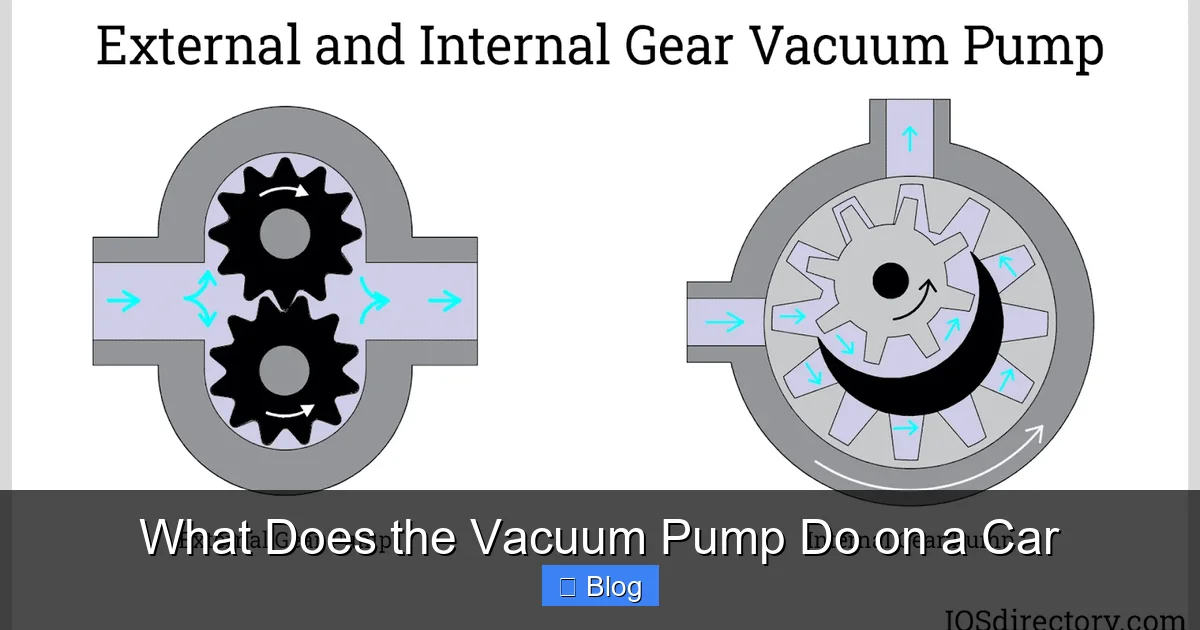
- Rotary Vane Pump: This type has a rotor with several vanes that slide in and out. As the rotor spins inside a chamber, the vanes sweep air from one side to the other, creating a low-pressure area (vacuum) on the intake side and pushing air out the exhaust side.
- Piston Pump: Similar to a tiny engine cylinder, a piston pump uses a piston moving up and down to draw air into a chamber and then expel it. This action creates the vacuum.
The vacuum pump on a car is usually driven by the engine, either directly (mounted on the camshaft or crankshaft) or by a belt. It runs whenever the engine is running, continuously generating and maintaining the necessary vacuum pressure in a dedicated vacuum reservoir or directly for the systems that need it. Some modern cars, particularly hybrids, might use an electric vacuum pump that operates independently of the engine, which can save fuel and provide vacuum even when the engine is off.
Signs of a Failing Vacuum Pump
Knowing what does the vacuum pump do on a car also means knowing how to spot problems. A failing vacuum pump can lead to serious safety issues and driving discomfort. Here are the common signs to watch out for:
1. Hard Brake Pedal
This is the most common and dangerous symptom. If your brake pedal feels unusually stiff and requires much more effort to push, especially after the car has been running for a while, it’s a strong indicator that your vacuum pump is failing or has failed. This means you’re losing power assist to your brakes.
2. Increased Braking Distance
Because you’re losing power assist, it will take longer and a greater distance to bring your car to a stop. This is a critical safety hazard and needs immediate attention.
3. Unusual Noises
A failing vacuum pump can make distinct noises. You might hear a:
- Squealing or whining sound: Often heard when the engine is running, particularly from the area where the pump is located. This could indicate a failing bearing or internal components.
- Ticking or clattering sound: Some mechanical vacuum pumps can produce these noises as internal parts wear out.
4. Dashboard Warning Lights
Modern cars often have sensors that monitor vacuum pressure. If the vacuum pressure drops too low, your car’s computer might trigger a “Check Engine” light or a specific brake system warning light. Don’t ignore these warnings.
5. HVAC Control Problems
If your car uses vacuum for HVAC controls, you might notice issues like:
- Air not blowing from the correct vents.
- Difficulty switching between defroster, floor, or dash vents.
- The climate control system not maintaining desired settings.
6. Engine Performance Issues (Less Common, but Possible)
If the vacuum pump also supports engine control systems (like EGR or turbo wastegate), a failure could indirectly lead to:
- Rough idle or stalling.
- Reduced engine power or acceleration.
- Poor fuel economy.
Troubleshooting and Maintenance Tips
If you suspect an issue with your vacuum pump, here are some steps and tips. Remember, due to the critical safety aspect (brakes!), professional help is often the best route.
1. Listen Carefully
With the engine running, try to pinpoint any unusual noises coming from the engine bay. A failing vacuum pump often makes a distinct mechanical sound.
2. Check Vacuum Lines
Sometimes, the issue isn’t the pump itself but a leaky vacuum line connected to it or the systems it supplies. Look for cracks, breaks, or loose connections in the rubber or plastic lines. A simple leak can cause a loss of vacuum.
3. Inspect for Leaks
Check the vacuum pump itself for any oil leaks. A leaking pump might indicate internal wear or seal failure.
4. Test the Brake Pedal
Start your car, let it run for a minute, then turn it off. Press the brake pedal several times. The first press should feel easy, the second slightly harder, and by the third or fourth, it should be very stiff. If the pedal is hard on the first press, you likely have a vacuum issue.
5. Seek Professional Diagnosis
Given the importance of the vacuum pump, especially for your brakes, it’s highly recommended to have a qualified mechanic diagnose any suspected issues. They have specialized tools to test vacuum pressure and can accurately determine if the vacuum pump is the culprit or if the problem lies elsewhere in the vacuum system or even the brake booster itself. Do not ignore symptoms of a failing vacuum pump, as it directly impacts your safety.
6. General Maintenance
Unlike some other car parts, the vacuum pump usually doesn’t have a specific maintenance schedule. It’s generally considered a “replace when it fails” component. However, during regular inspections, your mechanic might check the vacuum lines for cracks or wear, which can help prevent future problems. Keep up with your car’s routine service schedule, as it helps identify potential issues early.
Conclusion
Understanding “what does the vacuum pump do on a car” reveals a small but incredibly important component that plays a critical role in your vehicle’s safety, performance, and comfort. Whether you drive a powerful turbocharged sports car or a robust diesel truck, the vacuum pump ensures that your brakes are responsive and that other essential systems function as they should.
Recognizing the signs of a failing vacuum pump, such as a hard brake pedal or unusual noises, is crucial. Never ignore these warnings, as they can compromise your ability to stop safely. When in doubt, always consult with a professional mechanic. By staying informed and addressing potential issues promptly, you can ensure your car remains a reliable and safe mode of transport for years to come. Drive safely!